
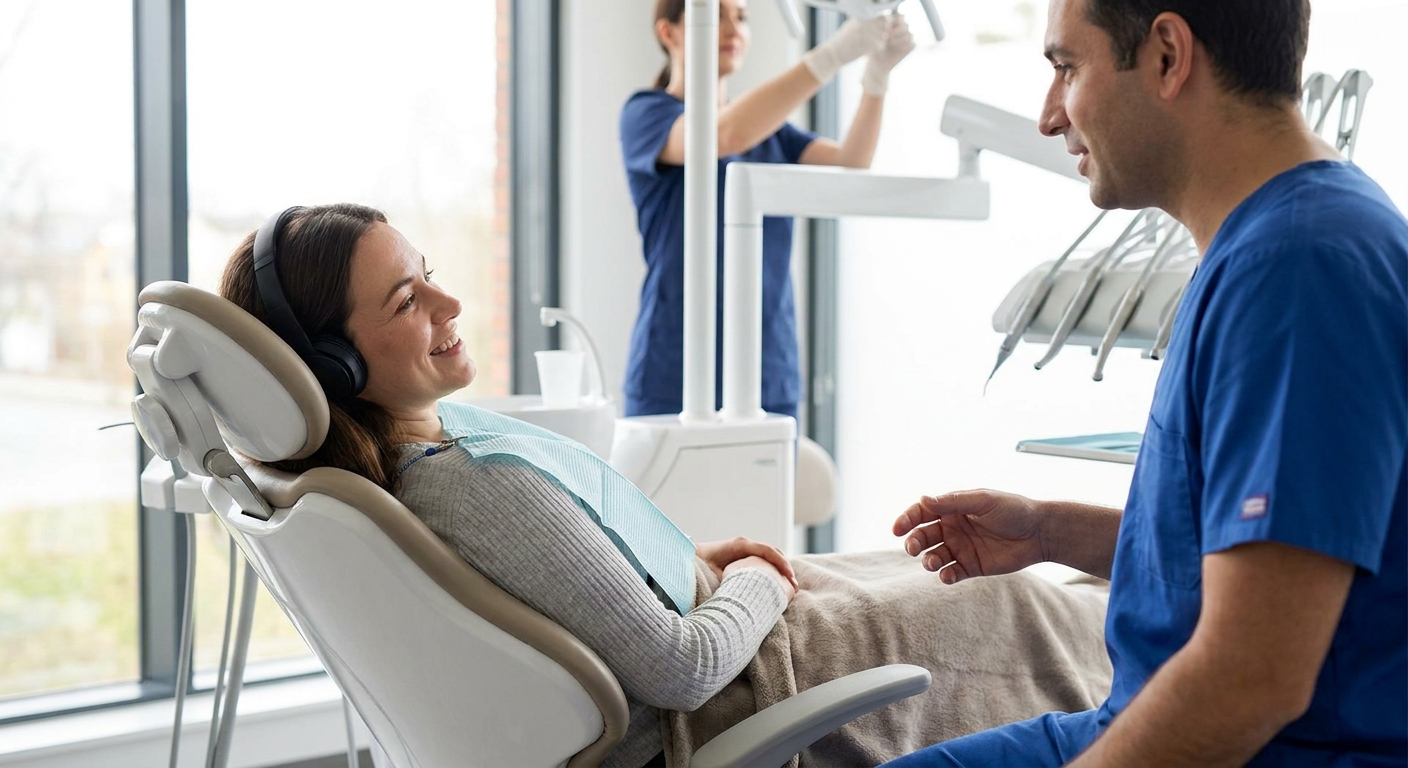
Dental anxiety keeps people out of the chair for years at a stretch, and sedation dentistry for anxious patients closes that gap by matching the right level of calm to the work that actually needs doing. This guide breaks down which sedation option fits which kind of fear, what a safe setup looks like in 2026, and where cheaper shortcuts put patients at risk.
- Nitrous oxide fits mild anxiety and short visits; it wears off about 5 minutes after the mask comes off. Best fit.
- Oral conscious sedation suits moderate fear and longer appointments; taken roughly 1 hour before arrival. Consider.
- IV sedation covers severe anxiety or multi-hour implant work under continuous monitoring. Best fit for complex cases.
- Skip any sedation offered without a written monitoring plan or escort requirement — that's a safety gap, not a convenience.
- Dental Arts of Atlantis matches sedation level to procedure and anxiety during a pre-visit consultation.
Why sedation dentistry for anxious patients matters
Dental anxiety isn't rare and it isn't something you just get over on your own. Avoiding routine visits for years lets a small cavity turn into a root canal, and a 20-minute cleaning turns into a multi-appointment rebuild once the neglect catches up.
Sedation dentistry for anxious patients isn't about being knocked out for every filling. It's about matching the right level of calm to the actual procedure, so you don't over-medicate for a cleaning or under-medicate for an extraction that's going to take an hour.
The practices that get this right build the plan around your specific trigger — needles, sound, the gag reflex, a bad experience from years back — instead of running the same protocol on everyone who says they're nervous.
Who this is for
This guide is for adults and teens who've delayed or skipped dental care because of fear of needles, the drill, or losing control in the chair, and for parents trying to figure out what's safe for a child who panics at cleanings. It's also for anyone facing a bigger case in 2026 — multiple implants, a full-mouth restoration, wisdom teeth — who doesn't have the bandwidth to get through it across five separate anxious visits.
What to look for in sedation dentistry for anxious patients
A documented anxiety assessment before sedation is planned
A real assessment covers your medical history, current medications, and specifically what triggers the fear — not just a checkbox for "nervous patient." Skipping this step is how people end up over-sedated for a cleaning or under-sedated for oral surgery.
Monitoring equipment that matches the sedation level
Nitrous oxide needs less oversight than oral conscious sedation, and IV sedation needs continuous monitoring: pulse oximeter, blood pressure cuff, and a team member watching vitals the entire time. If the monitoring doesn't scale with the sedation, that's a red flag.
More than one sedation option on the menu
A practice that only offers nitrous oxide can't help a patient with severe needle phobia facing a three-hour implant case. Range matters more than any single option being marketed hard.
Clear escort and recovery rules, written down
Oral and IV sedation both require someone to drive you home, and that rule should be stated before you book, not sprung on you at checkout. Vague answers here usually mean the aftercare plan is vague too.
A team that explains the plan in plain language
You should leave the consultation knowing exactly what you'll feel, when it wears off, and what happens if the first level doesn't work. Jargon-heavy explanations are a sign the plan wasn't actually built around your case.
The sedation options, ranked by anxiety level
Nitrous oxide — the low-key option. Onset runs 3 to 5 minutes and it wears off in about 5 minutes once the mask comes off, so there's no lingering fog and no driving restriction. It handles mild anxiety and short procedures like cleanings and small fillings without touching your schedule for the rest of the day. Verdict: Best fit for mild anxiety and routine visits.
Oral conscious sedation — the pill you take before you leave the house. You take it roughly 1 hour before the appointment, stay technically awake, and won't remember most of the visit clearly. It covers moderate anxiety and appointments running up to about 90 minutes, but you need someone to drive you and you're off the road for the rest of that day. A sedation consultation at Dental Arts of Atlantis is where the exact dose and timing get set based on your case, not a generic chart. Verdict: Consider if a cleaning or filling has been making you cancel appointments for years.
IV sedation — the option for real dread. Continuous monitoring through a pulse oximeter and blood pressure cuff runs the entire visit, and it can cover 3 to 4 hours of treatment in a single sitting with little to no memory of the procedure afterward. It's the right call for severe anxiety, multiple implants, or stacking several procedures into one visit instead of five. Verdict: Best fit for complex cases and patients who've been avoiding the chair for years.
Combination approach (nitrous plus local anesthesia) — the everyday default. It pairs the calming effect of nitrous with numbing gel or injectable local anesthesia, works for most routine restorative work, and needs zero recovery time — you drive yourself home. It still involves an injection, so it's not the pick for severe needle phobia. Verdict: Best fit for taking the edge off; Skip if needles are the actual trigger.
Talk through your sedation options
A short consultation maps the right level to your case before anything gets scheduled.
What to avoid
- Sedation "specials" sold as one-size-fits-all packages with no in-person anxiety assessment first — anxiety triggers vary too much for a flat protocol to work safely.
- Any provider who won't state their monitoring setup in writing for oral or IV sedation. If they can't name the equipment, don't book the procedure.
- Skipping the escort requirement because you feel fine. Moderate and deep sedation can slow reaction time for the rest of the day, not just during the appointment window — driving on it is a real risk, not a technicality.
Verdict comparison table
| Sedation type | Anxiety level | Onset | Duration covered | Recovery | Verdict |
|---|---|---|---|---|---|
| Nitrous oxide | Mild | 3-5 min | Standard short visit | None, drive yourself | Best fit |
| Oral conscious sedation | Moderate | ~1 hour before | Up to ~90 min | No driving for 24 hours | Consider |
| IV sedation | Severe / complex cases | Minutes after IV placed | 3-4 hours in one visit | Escort required, rest of day | Best fit for complex cases |
| Combination (nitrous + local) | Mild-moderate | Minutes | Standard restorative visit | None | Best fit for routine care |
FAQ
What is the best sedation dentistry option for anxious patients in 2026?
There's no single best option — nitrous oxide fits mild anxiety and short visits, while IV sedation fits severe anxiety or multi-hour cases. The right choice in 2026 still depends on your specific trigger and how long the procedure runs.
Is IV sedation safe for dental work?
IV sedation is safe when it's paired with continuous monitoring — pulse oximeter and blood pressure checks throughout the procedure. Ask any provider to confirm what monitoring equipment they use before you book.
How long does nitrous oxide take to wear off?
Nitrous oxide wears off in about 5 minutes after the mask is removed, since it doesn't build up in your system. That's why patients can drive themselves home right after.
Can I drive myself home after oral conscious sedation?
No. Oral conscious sedation requires an escort to drive you home, and you should avoid driving for roughly 24 hours after the appointment. The medication stays in your system longer than nitrous oxide.
Does insurance cover sedation dentistry?
Coverage varies by plan and by why the sedation is medically necessary versus elective. Ask for a written estimate and have the office check your specific benefits before the appointment.
Is sedation dentistry safe for children?
Nitrous oxide is commonly used for children with mild dental anxiety and wears off within minutes of removing the mask. Any sedation plan for a child should come after a full medical history review and a discussion of what's appropriate for their age and case.
How much does sedation dentistry cost?
Cost depends on the sedation type and how long the procedure takes, so it varies case by case. Get a written estimate during the consultation rather than relying on a general number.
What's the difference between conscious sedation and general anesthesia?
Conscious sedation — oral or IV — keeps you responsive to voice or touch even though you may not remember much afterward. General anesthesia puts you fully unconscious and is reserved for a much narrower set of cases.
One last thing
A lot of patients who finally get comfortable in the chair through sedation use that momentum to fix things they'd been avoiding for years alongside the fear — crowding, spacing, a bite that's bothered them since braces came off. If straightening is on that list too, Invisalign for adults covers how that process works once the restorative work is settled.