
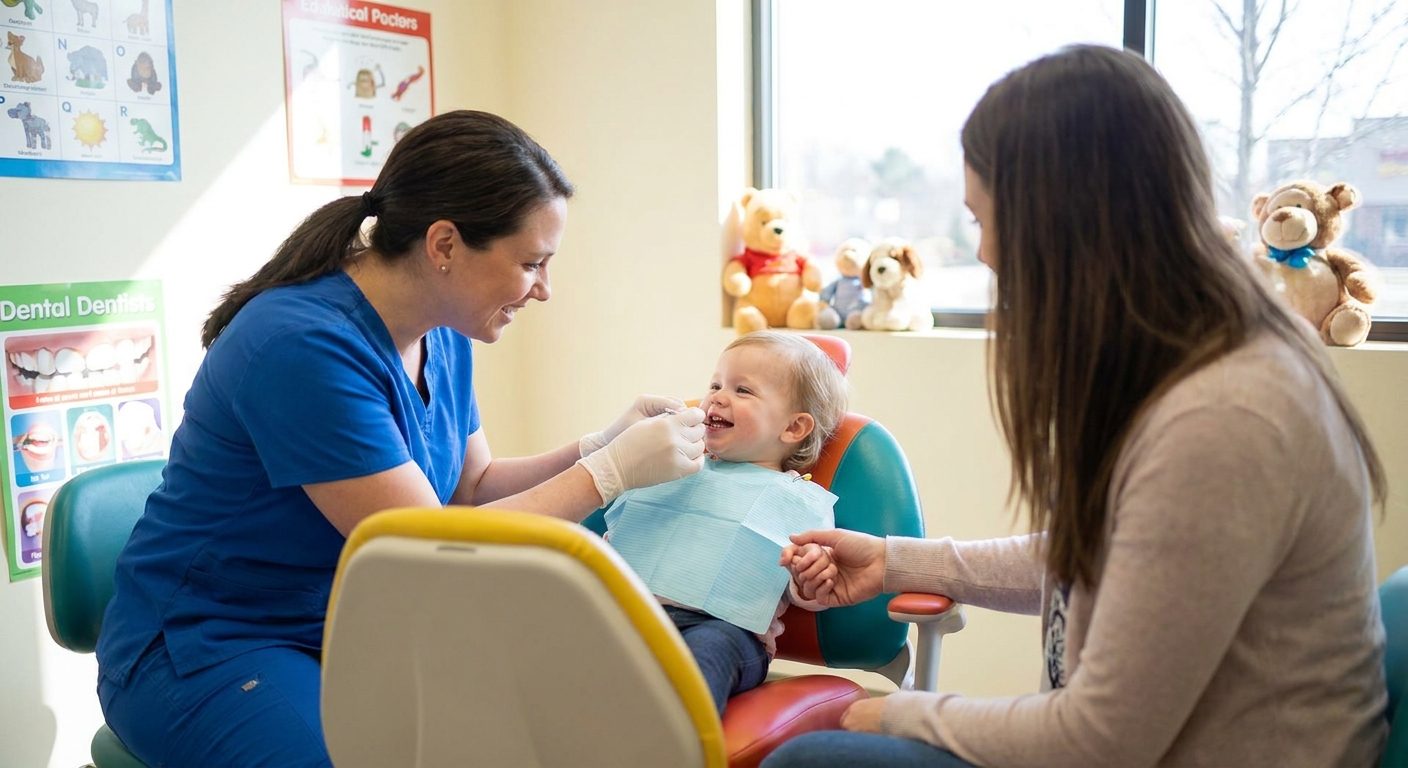
Picking a pediatric dentist for toddlers in 2026 comes down to five decisions: when to book the first visit, how the office handles a screaming two-year-old, and whether your whole family can be seen under one roof.
- Book a pediatric dentist for toddlers by age 1 or within six months of the first tooth. Buy.
- Skip routine X-rays before age 3 unless there's a specific concern raised at the exam.
- A family practice offering general, cosmetic, pediatric, and implant care under one roof cuts scheduling headaches. Buy.
- Sedation-free, tell-show-do behavior guidance beats restraint-based approaches for a toddler's first dental visit.
- Save Invisalign and orthodontic questions for the teen years, not the toddler checkup. Consider.
Why this matters
The American Academy of Pediatric Dentistry has recommended a first checkup by age 1 for decades, and that guidance still holds in 2026. Parents who wait until age 3 or later often show up to a first visit already managing a cavity, not just a checkup.
What changes year to year isn't the age-1 rule — it's how a practice handles that first visit once the toddler is in the chair. A calm, well-run first exam in 2026 sets the tone for every dental visit that follows, including the ones a decade from now when that same kid is a teenager weighing orthodontic options.
Who this is for
This guide is for parents in Palm Beach County with a child under age 4 who hasn't had a dental exam yet, or whose first visit went badly and needs a reset. It's also for parents juggling multiple kids at different ages who don't want three separate dental offices on three separate calendars.
Family practices such as Dental Arts of Atlantis handle general, cosmetic, pediatric, and implant care in one location, which matters most when a toddler's older sibling also needs a checkup the same afternoon. If your toddler has never been seen by a dentist, this is the exact decision point you're at right now.
What to look for in a pediatric dentist for toddlers
Experience with kids who won't sit still
A toddler exam isn't a mini version of an adult cleaning — it's often 15 to 20 minutes of distraction, short bursts of actual exam time, and a parent holding a hand. Practices that see toddlers regularly build their pacing around that reality instead of rushing a two-year-old through an adult-length appointment.
A visit built around age 1, not age 3
The first dental visit should happen by age 1 or within six months of the first tooth erupting, per longstanding AAPD guidance still current in 2026. A practice that pushes this back to "whenever they're older" is setting up a harder first visit later, not an easier one.
Behavior guidance before restraint
Tell-show-do — showing a toddler the mirror, the polisher, the count of teeth before touching anything — reduces fear far more effectively than holding a child still. Ask how the office handles a toddler who won't open their mouth; the answer tells you a lot.
One practice for the whole family
Scheduling a toddler, a school-age sibling, and a parent's own cleaning across three different offices burns a Saturday. A single family practice that covers general, cosmetic, and pediatric dentistry means one intake form and one location.
Imaging that matches the child's age
Routine X-rays aren't standard at a toddler's first visit unless the dentist sees a specific reason for one. Digital and 3-D imaging has a place in dentistry, but it belongs in the toolkit for later visits and specific concerns, not as a default for a two-year-old's first exam.
A comfortable, soft-and-gentle environment
The physical space matters for toddlers more than for any other age group. A waiting area with distractions, a chair-side manner that stays warm instead of clinical, and staff who talk to the child directly (not just the parent) all reduce first-visit anxiety.
Book your toddler's first dental visit
Family scheduling for pediatric, general, and cosmetic care in one office.
The decisions that matter most for toddlers
The by-age-1 visit — the non-negotiable. Booking the first exam by 12 months, or within six months of the first tooth, is the single decision with the most long-term payoff. It catches early decay before it spreads and gets a toddler used to the chair before fear has a chance to set in. Buy.
One-roof family scheduling — the convenience play. A practice covering general, cosmetic, pediatric, and implant dentistry under one appointment book means a toddler and a teenage sibling can be seen back-to-back instead of across two offices. For families juggling more than one kid's dental calendar, this is the difference between one Saturday and three. Buy.
Sedation-free behavior guidance — the anxiety antidote. Tell-show-do techniques and short, paced exams work for the vast majority of toddlers without any sedation at all. Reserve the sedation conversation for a dentist who raises it after trying behavior guidance first, not before. Buy.
Routine imaging on visit one — skip it for most toddlers. Unless there's a visible concern, a toddler's first visit doesn't need X-rays. Skip it at the first checkup; consider it later if the dentist flags a specific reason at a follow-up visit.
Same-practice teen orthodontics down the line — the long game. Toddlers eventually become teenagers who ask about straighter teeth, and a family practice that already knows the kid's dental history has a head start. If Invisalign ever comes up for an older child, Invisalign for adults covers how the process actually works once that day arrives. That's a consider, not a today decision — file it away.
What to avoid when choosing a pediatric dentist for toddlers
- A dentist who defaults to X-rays before trying behavior guidance. If imaging comes up before the dentist has even tried tell-show-do, that's a red flag for a two-year-old's first visit.
- An office with no separate pediatric space or distraction tools. A waiting room built entirely for adults, with no toys, screens, or kid-height chairs, tells you how the practice actually prioritizes toddlers versus how it markets itself.
- A general practice that treats a toddler like a small adult. Same instruments, same pacing, same 30-minute slot as a grown patient — that mismatch is exactly what turns a first visit into a bad memory.
Verdict comparison
| Criteria | What matters for toddlers | Verdict |
|---|---|---|
| First visit timing | By age 1 or within 6 months of first tooth | Buy |
| One-roof family scheduling | General, cosmetic, pediatric care in one office | Buy |
| Behavior approach | Tell-show-do before any sedation talk | Buy |
| Routine X-rays at visit one | Only with a specific concern flagged | Skip |
| Teen orthodontic planning | Comes later, not at the toddler stage | Consider |
FAQ
What age should a toddler first see a pediatric dentist?
A toddler should see a dentist by age 1, or within six months of the first tooth coming in. This timing has been AAPD guidance for years and still applies in 2026.
Is a pediatric dentist better than a general dentist for toddlers?
A pediatric dentist or a family practice experienced with toddlers is generally the better fit, since pacing and behavior guidance for a two-year-old differ from an adult exam. What matters more than the title is whether the office regularly sees toddlers.
What happens at a toddler's first dental visit?
A first visit is typically a short exam, around 15 to 20 minutes, focused on counting teeth, checking for early decay, and getting the toddler comfortable in the chair. Cleaning or X-rays usually wait for a later visit unless something specific is found.
How often should toddlers see the dentist after the first visit?
Most toddlers should be seen roughly every six months, or twice a year, after the first checkup. That schedule catches early decay while it's still easy to treat.
Do toddlers need X-rays at their first dental visit?
No, most toddlers don't need X-rays at the first visit unless the dentist sees a specific reason for one. Routine imaging is more common at later checkups, not the first exam.
Can a family dentist treat both toddlers and their older siblings?
Yes, family practices that offer general, cosmetic, pediatric, and implant dentistry can see a toddler and an older sibling in the same location. That's a scheduling advantage over splitting care across a pediatric-only office and a separate family dentist.
How do I prepare my toddler for their first dental visit?
Keep the language simple and positive, avoid words like "hurt" or "shot," and consider scheduling the visit for a time of day when your toddler is well-rested. A short practice run at home, counting teeth with a toothbrush, also helps.
How much does a toddler's first dental visit cost?
Cost varies by insurance coverage and the practice, so it's worth asking for a fee estimate before booking. Many insurance plans cover preventive checkups for young children at little to no out-of-pocket cost.
One last thing
Most toddlers have all 20 primary teeth by around age 3, which means everything that happens dentally before that point is setting the pattern for a full mouth of teeth, not just a few. The 2026 guidance hasn't changed the age-1 rule, but it has pushed more practices toward sedation-free, behavior-first visits — if an office still leads with restraint or a rushed exam, that's worth walking away from before the appointment even starts.