
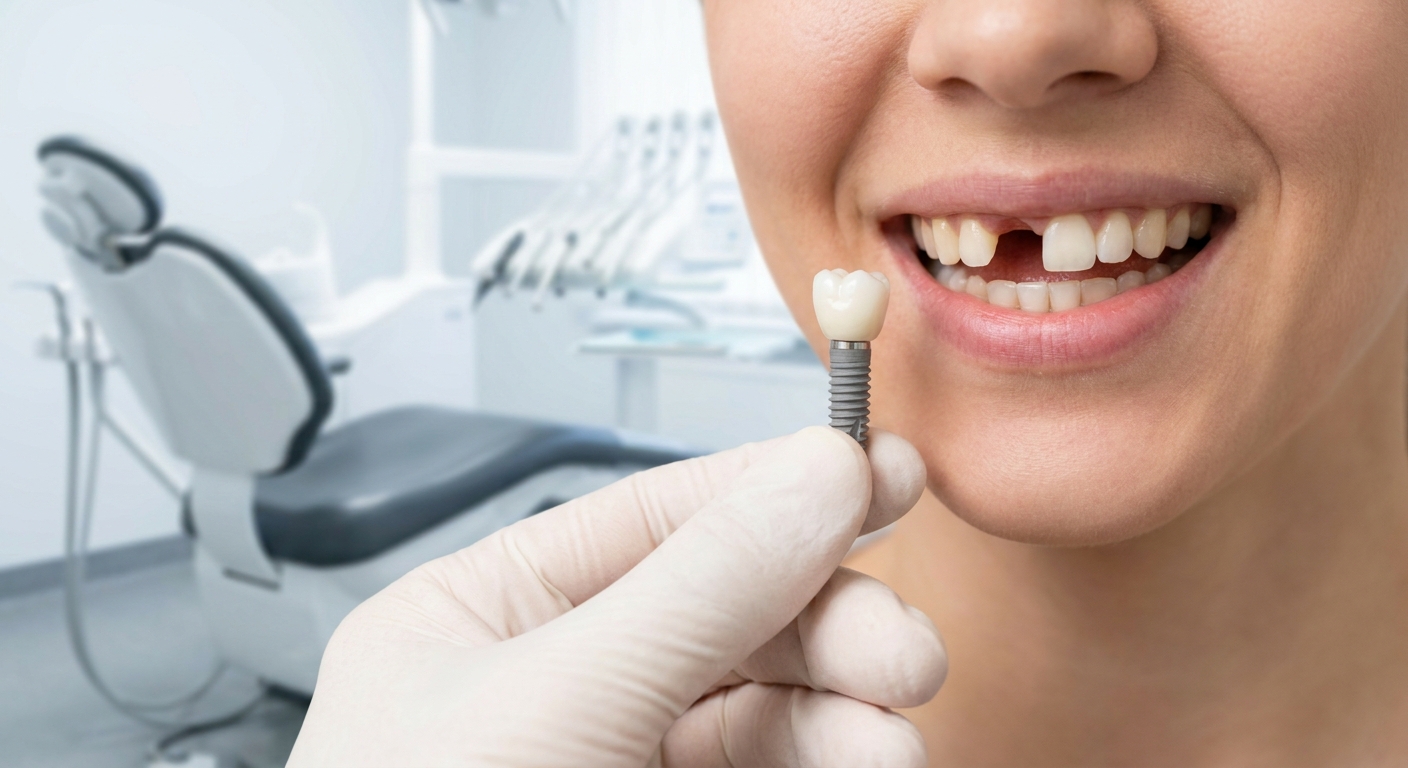
Losing one tooth doesn't sound like a big deal until you're the one avoiding photos or chewing on one side of your mouth. Dental implants for one missing tooth are the only option that replaces the root and the crown, so the jawbone stays stimulated and neighboring teeth stay untouched.
- A single-tooth implant is the top verdict for one missing tooth in 2026 — Buy if you have healthy bone and gums.
- A three-unit bridge is a Consider option only when adjacent teeth already need crowns.
- Removable partial dentures are a Skip for most adults under 60 due to bone loss over time.
- Dental Arts of Atlantis evaluates bone density and gum health before recommending any single tooth implant.
Why this matters
A gap left untreated doesn't stay the same size. The bone under a missing tooth starts resorbing within months, and neighboring teeth drift into the space, throwing off your bite. By 2026, implant dentistry has become the standard recommendation for a single missing tooth precisely because it's the only fix that stops that bone loss at the source.
Waiting also narrows your options. The longer the site sits empty, the more likely you'll need bone grafting before an implant can go in at all. That's a longer, more expensive path than acting in the first year after extraction or loss.
Who this is for
This guide is for adults in Palm Beach County who lost one tooth to decay, trauma, or an old failed root canal and want a permanent fix rather than something removable. It's built for people who chew on one side, avoid certain foods, or feel self-conscious about a visible gap, and who want a real comparison of what replaces a single tooth versus what just covers it up.
What to look for in dental implants for one missing tooth
Bone volume at the site
An implant needs enough jawbone to anchor into, usually confirmed with a 3-D scan before treatment planning starts. If bone has already resorbed, a graft adds healing time before the implant post goes in, so this is the first thing any dentist should check, not the last.
Gum health and any active infection
Implants fail at higher rates in patients with untreated gum disease, so a periodontal exam has to come before implant planning, not after. Treating gum inflammation first protects the investment you're about to make in a single tooth implant.
Timeline for osseointegration
The implant post needs time to fuse with the jawbone before a crown goes on top, typically three to six months depending on bone density and location in the mouth. Rushing this step is the single biggest cause of early implant failure, so a dentist who won't commit to a realistic timeline is a red flag.
Crown material and fit
The visible part of a single-tooth implant is a custom crown, and the material — zirconia versus porcelain-fused-to-metal — affects both appearance and how it wears against neighboring teeth. A crown that doesn't match your bite height will chip or loosen faster than one that's shaped to your actual occlusion.
What happens to the adjacent teeth
A true single-tooth implant doesn't touch the teeth on either side of the gap. That's the core advantage over a bridge, which requires grinding down two healthy teeth to anchor a false one in the middle.
Long-term maintenance plan
Ask what the follow-up schedule looks like once the implant is placed. A dentist who books a check at six months and again at one year is planning for the implant to last decades, not just get you out the door.
Top picks: your options for one missing tooth
Single-tooth dental implant — the standard, and the pick for most healthy adults. It replaces the root with a titanium or zirconia post, then tops it with a custom crown, and it's the only option on this list that stops bone loss at the site. Success rates for single-tooth implants have stayed above 95% over ten-year follow-up in dental literature cited through 2026. Buy if your bone density and gum health check out.
Implant-supported crown with same-day provisional — the option for people who won't tolerate a gap while healing. A temporary crown sits on the implant site while the post fuses with the bone over the following months, so you're never walking around with a visible hole. Buy if timeline matters as much as the final result and your dentist confirms the site is ready for a provisional.
Three-unit fixed bridge — the compromise pick. A bridge spans the gap using the two adjacent teeth as anchors, which means grinding those teeth down even if they're perfectly healthy. It's faster than an implant in some cases but doesn't stop bone loss under the missing tooth. Consider only if the adjacent teeth already need crowns for unrelated reasons — otherwise you're sacrificing healthy structure for convenience.
Removable partial denture — the budget-driven fallback. It clips onto neighboring teeth and comes out at night, and it does nothing to preserve the bone underneath the gap. Bone resorption continues at the same rate as leaving the tooth missing entirely. Skip for anyone under 60 with otherwise healthy teeth — it's a stopgap, not a solution.
Doing nothing — the option that looks free but isn't. Skipping treatment lets the bone resorb and the bite shift, both of which make future treatment more complex and costlier. Skip, full stop, especially if the gap is a molar doing real chewing work.
A dental practice that walks through 3-D imaging before recommending any of these options is doing the diagnostic work correctly — that's the standard Dental Arts of Atlantis uses for every implant consultation.
Find out if you're a candidate
A same-visit scan shows bone density and healing timeline before you commit.
What to avoid
Clear aligners marketed as a fix for a missing tooth. Invisalign moves existing teeth into better alignment, but it doesn't fill a gap or replace a root — if you're weighing options and see Invisalign for adults mentioned alongside implant treatment, understand it solves a different problem entirely.
Mini implants sold as a cheaper substitute for a full-size implant on a molar. Mini implants have a place for narrow spaces or denture stabilization, but they're not rated for the chewing force a back molar needs, and using one there invites early failure.
Any provider who skips the 3-D scan and quotes a price on the first visit. Bone volume and gum health determine whether you're even a same-day candidate, and a quote without that imaging is a guess, not a treatment plan.
Verdict comparison
| Option | Stops bone loss | Touches adjacent teeth | Verdict |
|---|---|---|---|
| Single-tooth implant | Yes | No | Buy |
| Implant with same-day provisional | Yes | No | Buy |
| Three-unit bridge | No | Yes, ground down | Consider |
| Removable partial denture | No | Clips on, not ground | Skip |
| Doing nothing | No | No | Skip |
FAQ
What's the best option for one missing tooth in 2026?
A single-tooth dental implant is the best option for most healthy adults in 2026 because it replaces the root and stops bone loss at the site. Bridges and partial dentures only cover the gap without addressing the bone underneath.
Is a dental implant better than a bridge for a single tooth?
Yes, for most patients, because an implant doesn't require grinding down healthy adjacent teeth the way a bridge does. A bridge can still make sense if those adjacent teeth already need crowns for other reasons.
How long does a single-tooth implant take to heal?
Osseointegration, the fusing of the implant post to the jawbone, typically takes three to six months. Healing time depends on bone density at the site and whether a graft was needed first.
Can I get a dental implant if I've lost bone in the jaw?
Yes, but you'll likely need a bone graft before the implant post can be placed. A 3-D scan during the consultation shows exactly how much bone remains and whether grafting is necessary.
Does Invisalign fix a missing tooth?
No, Invisalign moves existing teeth into better alignment but doesn't fill a gap left by a missing tooth. It solves crowding and bite issues, not tooth replacement.
How many visits does a single-tooth implant require?
Most single-tooth implant cases require at least two visits: one to place the implant post and a second, months later, to attach the finished crown. Same-day provisional crowns can reduce the visible gap during healing.
What happens if I skip replacing a missing tooth?
The jawbone under the gap starts resorbing within months, and neighboring teeth can drift into the space and shift your bite. This makes future treatment, including implants, more complex and often more expensive.
Are mini implants a good option for a missing molar?
No, mini implants aren't rated for the chewing force a back molar handles daily. They work better for narrow spaces or stabilizing a denture, not for replacing a molar under normal bite load.
One last thing
The detail most people miss: the tooth on the opposite side of your bite starts moving too once a molar goes missing, not just the teeth next to the gap. Without something opposing it to chew against, that tooth can super-erupt over months, which is one more reason the window for an easy fix closes faster than most people expect going into 2026.